1. Describe it to your AI
Ask in plain language through your tenant's MCP server ({tenant}.plaid.cloud/mcp), from a Claude connector or any MCP-capable AI. No boilerplate and no infrastructure to wire up.

Describe the app you need to your AI. PlaidCloud builds and serves it as a secure HoloViz Panel app, WASM or server-side, running directly on your lakehouse tables, workflows, dimensions, and access controls.
How it works
Ask in plain language through your tenant's MCP server ({tenant}.plaid.cloud/mcp), from a Claude connector or any MCP-capable AI. No boilerplate and no infrastructure to wire up.
Your app is built automatically and served as a HoloViz Panel app, WASM in the browser or server-side: versioned, monitored, and ready to share in minutes.
The app reads your lakehouse tables, workflows, and dimensions under your existing roles and permissions. Secure by default, at scale.
Apps that fit your business exactly
Off-the-shelf SaaS apps force your process into their template. On PlaidCloud, your people describe the app they actually need and get it in less time than a SaaS configuration project, running on your data instead of another vendor's copy of it.
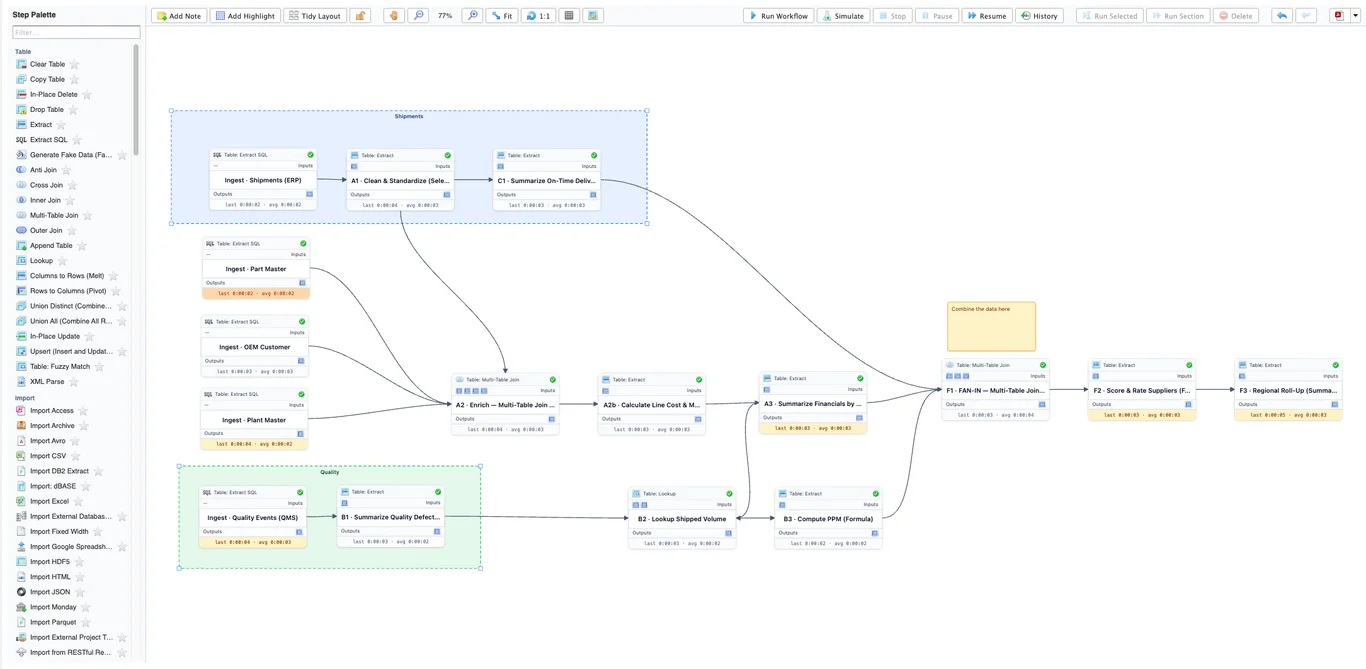
Your roles and permissions apply to every app
Every app runs inside your tenant under the same roles, permissions, and lineage as the rest of PlaidCloud. Data never leaves your governed platform, and access can be as broad or as narrow as the audience requires.
Two ways to serve: WASM or server-side
Apps are standard HoloViz Panel applications, built and hosted by PlaidCloud. Serve them as WASM so the app runs entirely in the user's browser, or server-side when the app should run next to the data. Either way, PlaidCloud's automated build process takes care of everything: no local development environment, no Python setup, no build tooling.
Provided repos, or bring your own GitHub / GitLab
Every Panel app is backed by a Git repository. Use the repos PlaidCloud provides, or connect your own GitHub or GitLab. AI edits land as commits, so every app has reviewable history and rollback like any other codebase.
What teams build
A weekly margin-movement review for sales leaders, reading live allocated P&L from the lakehouse.
A month-end close tracker that watches workflow run status and flags late or failed steps.
A self-service explorer for plant controllers to drill from site cost to the transactions behind it.
A governed form that collects allocation driver updates from the business and lands them in model tables.
Point your AI at your tenant's MCP server, describe the app you need in plain language, and PlaidCloud builds and serves it as a HoloViz Panel app. There is no local development environment, hosting, or build tooling to set up.
Panel is a leading open-source Python framework for building interactive data apps: dashboards with inputs, forms, drill-downs, and custom logic. PlaidCloud apps are standard Panel applications, so they are portable Python, not a proprietary format.
Yes. PlaidCloud builds and hosts HoloViz Panel apps end to end, served either as WASM running in the browser or server-side next to your data, with versioning, monitoring, and your access controls applied.
WASM apps run entirely in the browser, so there is no server to size and they scale effortlessly for broad audiences. Server-side apps run inside your tenant next to the data, which suits heavier computation and tighter data access. PlaidCloud builds and serves both.
No. PlaidCloud runs an automated build process, so you can create, edit, and deploy Panel apps entirely from the platform, including with AI. Nothing to install locally.
Every app is backed by a Git repository. PlaidCloud provides repos out of the box, or you can bring your own GitHub or GitLab. AI edits arrive as commits, so history is reviewable and revertible.
Every PlaidCloud tenant includes its own MCP (Model Context Protocol) server at {tenant}.plaid.cloud/mcp. It exposes your tables, workflows, dimensions, and app deployment to any MCP-capable AI, such as a Claude connector, under your access controls.
Yes. Apps run inside your tenant and read data under your existing roles and permissions. Nothing is exposed publicly unless you choose to share it, and access is controlled the same way as the rest of PlaidCloud.
Bring one real need to a 30-minute session and leave with a deployed app on your own data.
We use cookies to analyze site traffic and improve your experience. See ourCookie Policy.