
Alteryx has been a fixture in finance and analytics teams for years, valued for its low-code approach to preparing and blending data. Over the last two years the company has changed in ways that have many finance and operations leaders asking a fair question: is a general-purpose data platform still the right home for our costing and profitability work, or is it time to look at an alternative?
This is a neutral look at what actually changed, where Alteryx still earns its place, and the signals that suggest a purpose-built platform would serve a finance team better.
What Actually Changed at Alteryx
Two shifts matter most for buyers evaluating the platform today.
New ownership. Alteryx was taken private by Clearlake Capital and Insight Partners in a deal valued at roughly $4.4 billion. The acquisition was announced in late 2023 and closed in March 2024. Going private is a normal path for a mature software company, but it typically comes with a renewed focus on profitability and a reshaped roadmap, both of which influence pricing and product direction.
Alteryx One licensing changes. Alteryx has since moved to a repackaged model under the “Alteryx One” banner, with user-based editions and a consolidated way to license its products. On-premises Designer and Server were brought under the new licensing model as well. The exact figures vary by edition and deployment, so the most reliable source for current numbers is an Alteryx quote. The practical point for finance teams is that the packaging and per-user structure changed, which is reason enough to revisit whether the fit and cost still make sense.
Why This Matters More for Finance and Operations
Alteryx is a broad, capable data-preparation and analytics platform. That breadth is a strength for general analytics, but it is also the crux of the question for finance.
Cost allocation, activity-based costing, intercompany invoicing, and transfer pricing are not generic data-blending problems. They depend on multidimensional models, driver-based logic, repeatable allocation methodologies, and traceability that holds up to an audit across jurisdictions. In a general-purpose tool, that machinery has to be built and maintained from scratch by whoever owns the workflow. When that person leaves, the model can become a black box.
When licensing is priced per seat, the cost of giving every finance and operations stakeholder access can climb quickly, which often pushes organizations to limit who can actually work in the tool.
When Alteryx Is Still the Right Choice
To be fair to the platform: if your primary need is flexible, general-purpose data preparation across many domains, if you have analysts comfortable building and maintaining workflows, and if your costing needs are light, Alteryx remains a strong, mature option with a large community and broad connectivity.
Signs It Is Time to Consider an Alternative
Finance and operations teams tend to start weighing an Alteryx replacement, or leaving Alteryx altogether, when:
- Cost allocation, activity-based costing, or transfer pricing is central to the work, not occasional.
- Per-user licensing makes it expensive to give every stakeholder access.
- Critical models live as hard-to-audit workflows that only one or two people understand.
- You need profitability and margin reporting with traceability built in, not assembled from separate tools.
- You want finance and operations users, not data engineers, to own the models.
How PlaidCloud Approaches It
PlaidCloud is a low-code, fully web-based platform purpose-built for exactly this work. Instead of starting from generic building blocks, finance teams start from pre-built models for cost allocation, activity-based costing, enterprise profitability, and operational transfer pricing, with the multidimensional hierarchies and jurisdiction-level traceability these calculations require. Pricing is not per seat, so the whole team can participate.
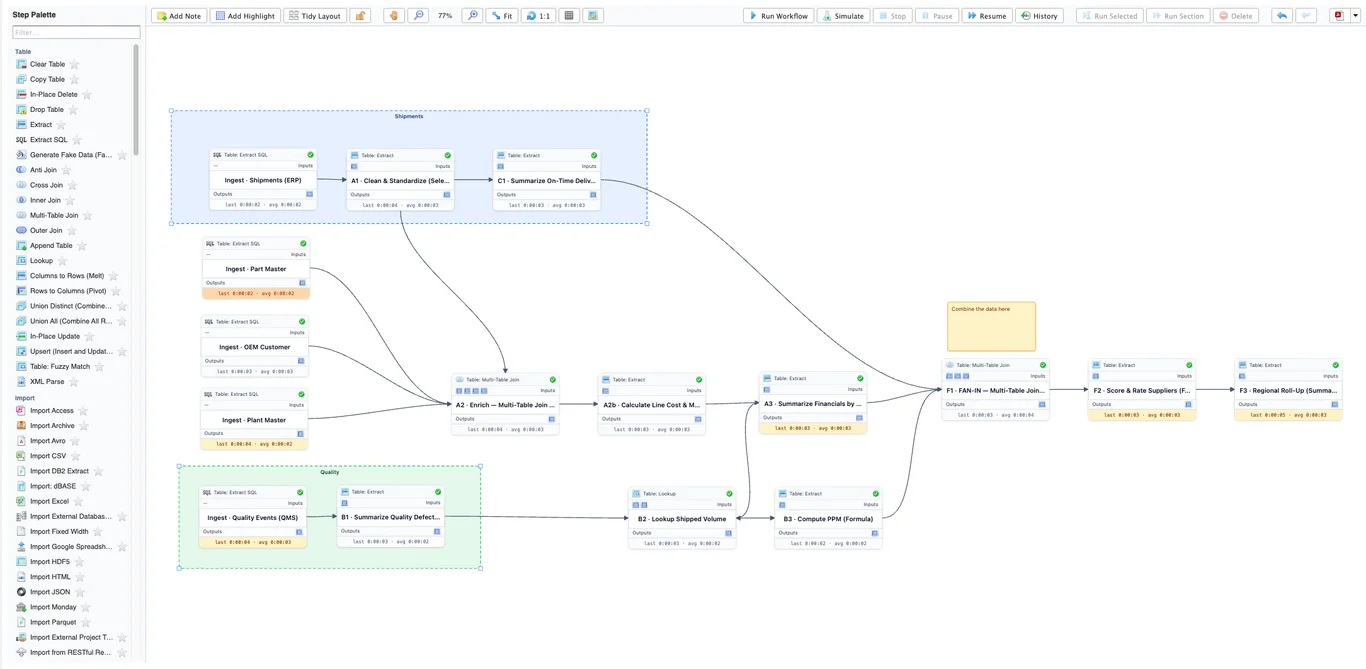
Models are built visually in PlaidCloud. Each step is point-and-click and fully traceable, so finance and operations teams own the logic instead of maintaining hand-written workflows.
If you are weighing the move, our Alteryx alternative overview compares the two approaches side by side for finance and operations use cases.
Frequently Asked Questions
Who owns Alteryx now? Alteryx is privately held by Clearlake Capital and Insight Partners, which acquired it in a deal valued at roughly $4.4 billion that closed in March 2024.
What is Alteryx One? Alteryx One is the company’s repackaged, user-based licensing and product model. On-premises Designer and Server were brought under it, consolidating how the platform is licensed.
Is there a finance-specific alternative to Alteryx? Yes. PlaidCloud is purpose-built for finance and operations work such as cost allocation, activity-based costing, profitability, and transfer pricing, with pre-built models and audit-ready traceability rather than generic data-prep building blocks.
Does switching mean rebuilding everything? No. PlaidCloud connects to the same ERPs, databases, flat files, and spreadsheets, and ships ready-made models so teams typically reach results faster than rebuilding logic from scratch.
Did Alteryx pricing and licensing change? Yes. Alteryx moved to the user-based “Alteryx One” model and brought on-premises Designer and Server under it. Because the packaging and per-user structure changed, the most reliable source for current pricing is an Alteryx quote, and these Alteryx One licensing changes are a common reason finance teams revisit fit and cost.
What is the best Alteryx replacement for finance teams? For teams whose work centers on cost allocation, activity-based costing, profitability, and transfer pricing, a purpose-built platform is usually a better replacement than another general-purpose tool. PlaidCloud ships pre-built finance models with audit-ready traceability; see the Alteryx alternative overview for a side-by-side comparison.
The Takeaway
Alteryx’s ownership and licensing changes are a good prompt to step back and ask whether a general-purpose data platform is still the best fit for your costing and profitability work. For teams where that work is central, a purpose-built alternative can lower the total cost of access, shorten time to value with ready-made models, and give finance the traceability it needs. If that sounds like your team, book a demo and we will walk through your specific costing scenario.