
AI You Can Trust: How PlaidCloud Keeps Your Numbers Grounded
Anyone can make AI generate an answer.
PlaidCloud makes AI prove it.
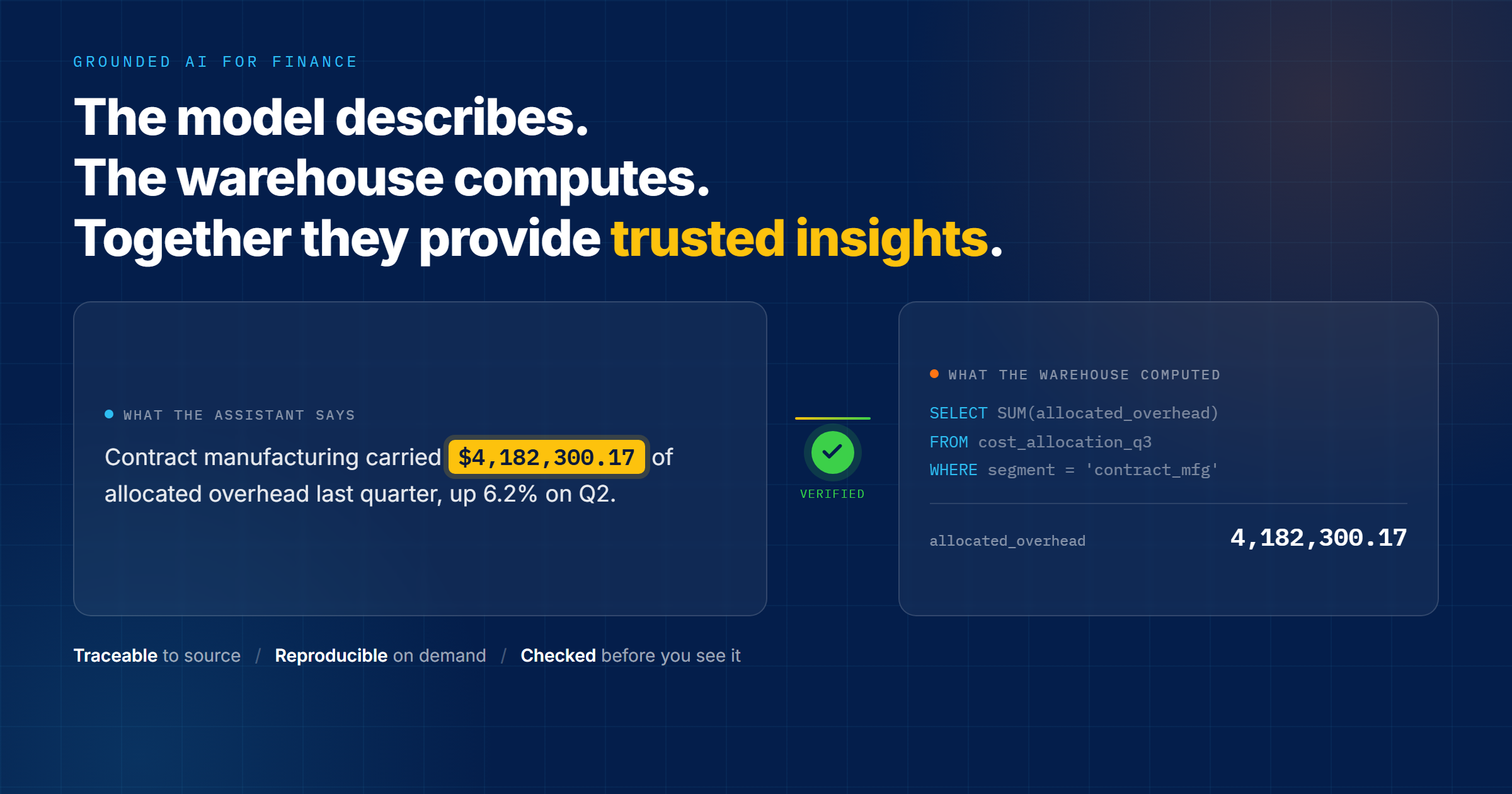
Put an AI assistant next to your financials and the first question every CFO, controller, and auditor asks is the right one: can it make numbers up? Many AI finance systems have a cause for concern, because they let the model do the math. Ask it for an allocation and it will happily return a figure, formatted to the cent, with no way to tell whether it computed it, remembered it, or invented it.
PlaidCloud takes that failure mode off the table by construction, not by prompting. The difference is a smart, purpose-built architecture that holds even when the prompt does not. The foundation (the warehouse computes everything) has been in PlaidCloud’s DNA since day one; the honesty layer built on top of it is newer, and deliberate. Because here is the honest version of the claim: the figures cannot be invented, but the sentence around them still can be wrong. So we check that too, and this post explains both halves.
AI never does the math
Allocations, roll-ups, and every derived figure are computed by the PlaidCloud workflow engine as SQL in the warehouse. No figure in an answer originates in the model. Where AI writes logic, it writes SQL you can read, review, and re-run; it never evaluates the arithmetic itself.
That single design choice removes an entire class of hallucination. The AI cannot fabricate an allocation because it was never the thing doing the allocating. You are not hoping a clever prompt keeps it honest; the number it reports is the number the warehouse already computed.
The same design discipline governs certainty itself. An answer is only ever as confident as the weakest data behind it, so a shaky input is never dressed up as a sure conclusion. That is why the architecture breeds confidence: it protects the integrity of every result, not just the arithmetic.
Every figure carries its lineage
Ask where a number came from and the answer is not the model’s best guess about how the system probably works. The trace walks the actual step graph: the real wiring of your model, stage by stage, back to the source tables it started from. It is reading the model, not recollecting it.
Reproducibility is paramount
Traceability is table stakes. Reproducibility is the real bar. Every answer ships with its derivation and states the basis it used, so when a number moves you can see whether the data moved or the model did. The derivation is re-executable; the trace can hand you the actual SQL it ran.
That integrity is what makes the answers usable in real work. Re-run a scenario and see exactly what it rests on. Segment the same result by customer, SKU, or location, and where the pieces do not sum to the whole, it says so, and says how much is unaccounted for. Nothing depends on what the AI happened to say last time; everything rests on logic you can execute again. “Go and check the source data” is not an invitation to go looking. We hand you the working, literally.
We test the prose, not just the numbers
A correct number wrapped in a misleading sentence is still a lie, and it is rarely tested. We do, and we do it two ways.
A persona benchmark runs realistic questions through the system and checks the answers against independently written SQL, so the numbers are verified against a second source of truth rather than against themselves. A cold-read audit hands a reader only the report text, no data, and asks what they would be misled into believing. If the words around a right number would steer an honest reader wrong, that is a defect, and we treat it as one.
Testing whether the sentence is honest, not just whether the figure is right, is the differentiator. And it is demonstrable.
Every answer is checked before you see it
Testing is not just something we did once in a lab. Every narrative can be checked against the data payload it claims to describe, by a deterministic verifier with no AI model and no network call inside it. It fails the narrative for three things: a currency or percentage figure that is not in the payload, a warning the payload carried that the sentence dropped, and a confidence level the payload assigned that was left unstated.
This works because confidence and caveats are structured fields in the answer, not tone; a sentence that quietly drops one fails the check. And because the verifier is pure and local, it can run on every answer, and the assistant runs it on itself before showing you anything. That converts “we test the prose” from a QA anecdote into a runtime guarantee.
The most powerful demonstration is knowing where the data ends
The most reassuring thing PlaidCloud can do is tell you exactly what it knows, and where the data no longer supports a conclusion. Concretely: where a stage cannot be measured, the answer returns it as unknown, never as zero, and tells you the chain below it was not explored. Unknown is a fact; zero is a guess wearing a fact’s clothes.
When PlaidCloud says “I can attribute profitability to this point, and here is exactly why,” it demonstrates something more valuable than another perfect-looking answer: confidence grounded in evidence.
Anyone can build an AI that produces answers. The AI worth trusting is the one that understands the limits of the data, makes those limits transparent, and never pretends to know more than it does. That is not a limitation. That is intelligence you can trust.
Trust isn’t a nice-to-have; it’s mandatory
With PlaidCloud, AI-generated numbers are grounded in a system engineered for accuracy, traceability, and proof. It is how we architected the platform. Every number is connected to its underlying data and the logic used to produce it.
No invented numbers. No unexplained conclusions. Just answers you can trace, validate, re-create, and trust. That is how we make AI-ready profitability intelligence enterprise-ready and give you confidence in your results, not AI hallucinations.
See how PlaidCloud grounds AI in your data or book a demo and ask it something it should refuse to answer.
· Paul Morel · Article · 6 min read